


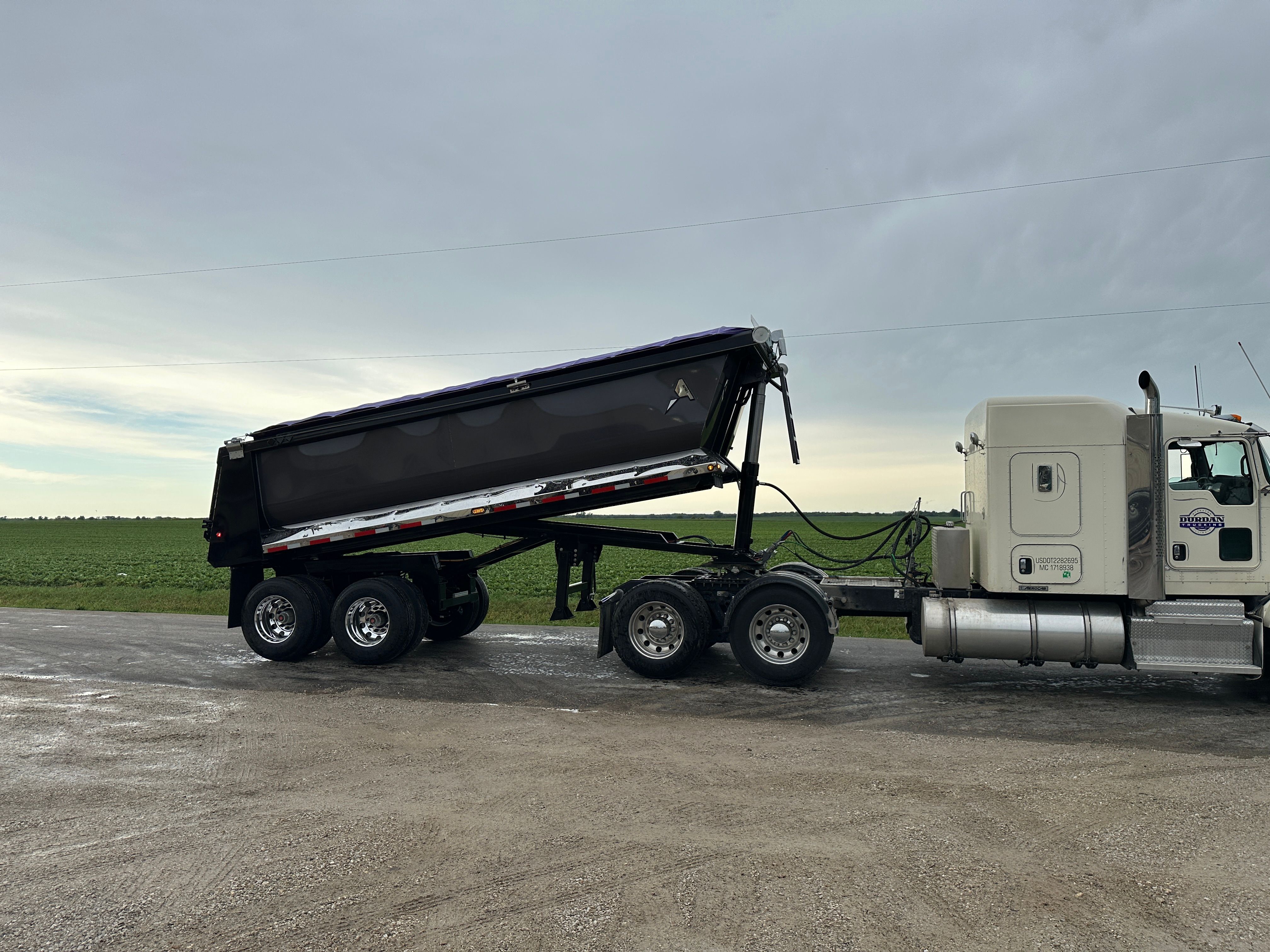
What Is GVWR on a Trailer? Dump Trailer Payload Explained
t
tj@civsav.com
© 2026 Civilized Savage
Based in USA
tj@civsav.com
If you are asking what is GVWR on a trailer, it is the maximum total weight the trailer is rated to have when fully loaded. That rating covers the empty trailer plus everything in the body, so it does not tell you how much material you can carry. For that, you need one more step.
GVWR stands for gross vehicle weight rating. The National Highway Traffic Safety Administration explains in interpretation letter nht75-5.2, checked November 5, 2026, that a trailer’s GVWR is the weight of the empty trailer plus its rated cargo load. The same letter says a tractor and a trailer are treated as two separate vehicles, each with its own rating. So GVWR is a ceiling set by the builder, not a target to aim for. To see how load placement changes the weight carried by each axle, read our guide to payload capacity and weight distribution on dump trailers.
GVWR is the manufacturer’s rating for the complete trailer. On a dump trailer, dense materials like gravel, wet soil, and concrete add weight fast, so use a scale instead of judging a load by how full the body looks. That is why GVWR matters more to a hauling crew than cubic yards do.
GVWR is also a regulatory number. The Federal Motor Carrier Safety Administration uses a 10,001 pound threshold to decide whether a vehicle is a commercial motor vehicle in interstate commerce. FMCSA regulatory guidance includes an example that adds the truck GVWR and the trailer GVWR together when considering that threshold. Your state may add its own licensing, registration, and weight rules, so confirm requirements with the agency where you run.
GVWR varies a lot from one dump trailer to the next. ALKO’s FAQ says its commercial models range from 10,000 to over 40,000 pounds GVWR. Always read the label on the exact trailer in front of you.
GVWR is a rating. GVW, or gross vehicle weight, is a measurement. The rating stays the same for a given trailer. The measurement changes every time you load, dump, or add equipment. Put simply, GVWR is the most the loaded trailer is rated to weigh, and GVW is what it actually weighs right now. This difference matters at the scale house, so weigh a representative loaded trailer on a certified scale instead of guessing by volume.
| Term | What it means | Where you get it |
| GVWR | Maximum rated loaded weight of the trailer | Builder's weight label or VIN plate |
| GVW | Actual weight of the trailer as loaded right now | Certified scale ticket |
| Empty weight | Weight of the trailer with no cargo | Spec sheet, or weigh it empty |
| Payload | Cargo weight you may carry | GVWR minus empty weight |
| GAWR | Maximum rated weight for one axle | Weight label, listed per axle |
Payload is simple subtraction once you have two accurate numbers. Follow these steps.
Here is a worked example. Say a trailer label shows a 14,000 pound GVWR and the trailer weighs 5,182 pounds empty. Then 14,000 minus 5,182 equals 8,818 pounds of payload. This is an illustration only. It is not an ALKO model, and those figures are not ALKO specifications.
Each axle has its own gross axle weight rating, or GAWR. It is the most weight assigned to that axle. The sum of the axle ratings does not by itself set a trailer’s GVWR or payload. Keep the weight on each axle within its listed rating, and keep the whole trailer within its GVWR. If you pile a load toward the tailgate, the rear axle can pass its rating even while total trailer weight still reads under the GVWR.
Tongue weight, or pin weight on a gooseneck, moves part of the loaded trailer weight onto the tow vehicle. That is why your truck’s ratings must be checked separately. Our guide to matching a truck to a dump trailer covers that side in detail, so this article stays on the trailer numbers.
Check the manufacturer’s weight label and the trailer paperwork for the GVWR and axle ratings. If the label is missing or unreadable, contact the builder with the VIN instead of guessing.
Before you buy, ask the builder for written specifications instead of relying on a sales conversation. ALKO builds its dump trailers in Varna, Illinois with American steel. Look through the full frame dump trailer range and ask ALKO for the spec sheet on the exact build you are considering.
Yes. NHTSA states that a trailer’s GVWR is the empty trailer weight plus its rated cargo load. That is why you subtract the empty weight to find payload. The tow vehicle is rated separately, so its weight is not part of the trailer’s GVWR.
It means the trailer is rated to weigh no more than 7,000 pounds fully loaded. Cargo capacity is 7,000 pounds minus the trailer’s empty weight. A heavier trailer leaves less payload than a lighter one with the same rating, so weigh your own unit.
No. GVWR includes the weight of the trailer itself. What you can haul is the payload, which is GVWR minus the empty weight of your specific trailer. Axle ratings and your tow vehicle ratings can lower that number further.
Do not assume larger axles or tires raise the GVWR on the label. The manufacturer assigns GVWR for the complete trailer. Ask the manufacturer and your state authority before relying on a modified trailer for a higher rating.
A 14,000 pound trailer rating alone does not answer the licensing question. Requirements depend on the truck and trailer combination, how you use it, and the state where you operate. Check your state agency for the rule that applies to your route and use.
You are operating the trailer beyond its rated limit. Keep the loaded trailer within its GVWR and axle ratings, and check actual weight on a certified scale when you are unsure. Your state agency sets the enforcement rules where you run.
Once you know what is GVWR on a trailer, the routine is short. Read the rating off the label, weigh your trailer empty, subtract to find payload, then check the axle ratings and your truck before you load. Scale a real load early so you learn what your materials actually weigh.
ALKO Dump Trailers builds heavy-duty dump trailers in Varna, Illinois with American steel and local labor. Ask for a spec sheet or a free quote at ALKO Dump Trailers.